About This Project
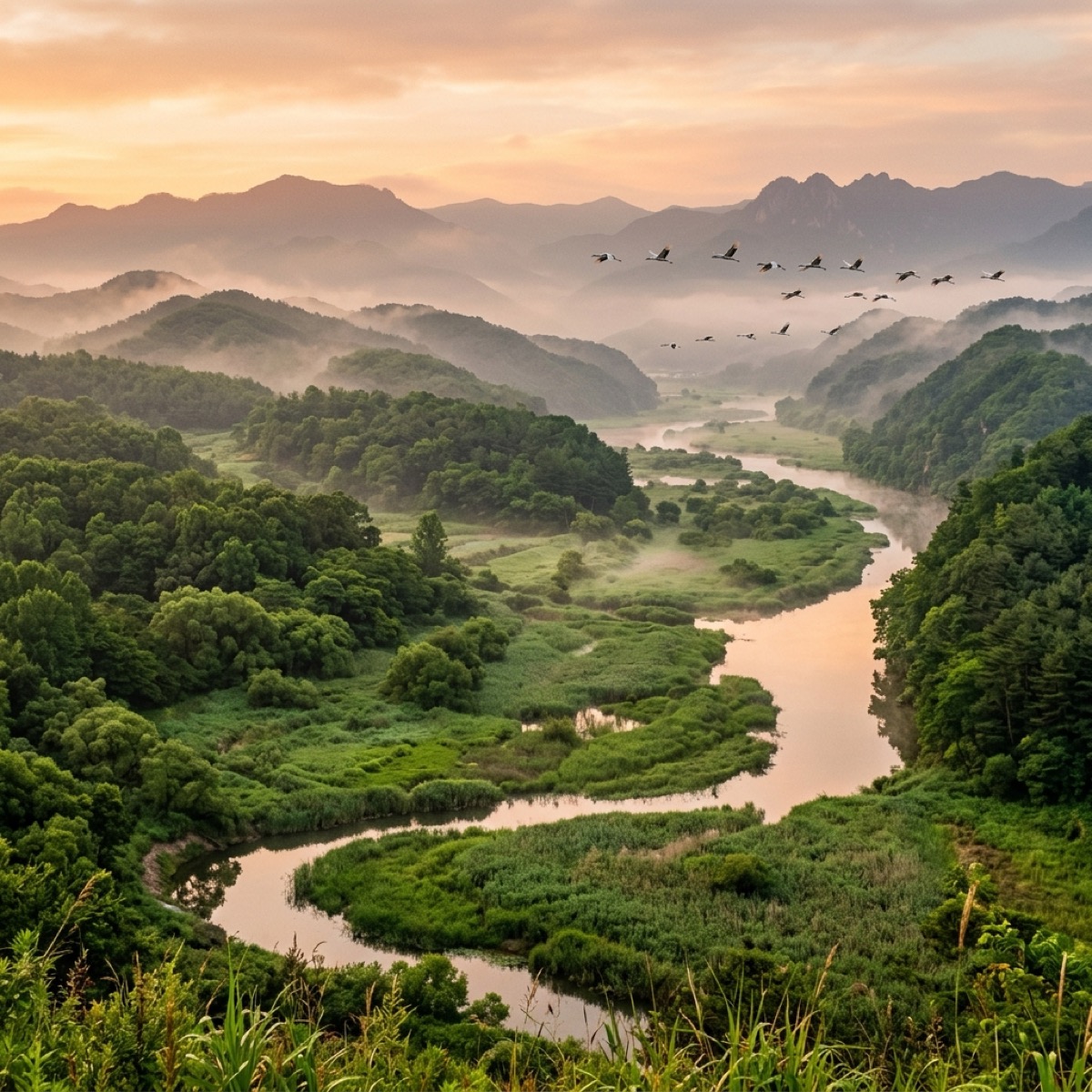
The Korean Demilitarised Zone (DMZ) is one of the most paradoxical places on earth. A 250-kilometre-long, 4-kilometre-wide strip of land dividing the Korean Peninsula, it has been virtually untouched by human activity for over seven decades. In that time, nature has reclaimed it entirely — creating an accidental wildlife sanctuary that harbours some of East Asia's rarest and most endangered species.
The Cheorwon Plain, situated at the DMZ's central western corridor, is a globally significant wetland and the winter home of the red-crowned crane (Grus japonensis) — a species sacred in Korean culture and classified as Endangered by the IUCN, with fewer than 2,800 individuals remaining worldwide. Alongside the cranes, the Cheorwon DMZ corridor supports white-naped cranes, Asiatic black bears, leopards, and over 5,000 plant and animal species, many found nowhere else on the Peninsula.
The DMZ Nature Peace Education Program transforms this extraordinary landscape into a living classroom. We bring middle and high school students from across Korea to the DMZ buffer zone for immersive, multi-day ecological field programmes that connect environmental science with the Korean story of division, resilience, and hope. Our goal is not just education — it is the creation of a generation of young Koreans who see the DMZ not as a scar of war, but as a beacon of what nature can achieve when given the chance.
"When a 15-year-old student sees a red-crowned crane take flight over the DMZ for the first time, something changes in them permanently. They understand, in that moment, that peace and nature are the same thing."
— Yoon Hae-ri, Lead Educator, Dasom Saessak DMZ Programme
The Challenge
Nature-Deficit Generation
A 2023 Korean Educational Development Institute (KEDI) study found that 72% of Korean middle school students spend less than 30 minutes per week in any natural environment. Urban-centred exam culture leaves almost no room for ecological literacy, producing a generation disconnected from the natural systems their future depends on.
DMZ Access Restrictions
The DMZ's extraordinary biodiversity exists precisely because it is closed to the public. Civilian access to the Civilian Control Zone (CCZ) requires military permits, specialist guides, and strict safety protocols — barriers that make educational programmes logistically complex and expensive to operate at scale.
Development Pressures
The CCZ buffer areas immediately south of the DMZ face escalating pressure from solar farm development, road construction, and tourism infrastructure. Without a constituency of informed young advocates, political support for DMZ conservation will erode within a generation.
Climate Disruption of Migration
Warming winters are disrupting the red-crowned crane's migration patterns. The Cheorwon wintering population has declined from 1,200 individuals in 2015 to approximately 940 in 2024. Students trained in citizen-science monitoring are essential for tracking these shifts in real time.
Our Approach
We deliver a three-tier education model designed in collaboration with KEDI, the National Institute of Ecology (NIE), and the Cheorwon County Office of Education — aligning with Korea's 2022 Revised National Curriculum framework for ecological citizenship.
In-School Preparation (4 Weeks)
Before students set foot near the DMZ, our certified educators visit partner schools for a 4-session preparatory module. Students learn DMZ history, Korean Peninsula ecology, bird identification, and field survey methodology. Each student receives a Saessak Field Journal — a custom-designed workbook that guides their observations throughout the programme and becomes their personal scientific record.
DMZ Field Expedition (3 Days)
The centrepiece of the programme: a 3-day, 2-night immersive expedition to the Cheorwon CCZ. Under military permit and specialist guide supervision, students conduct real biodiversity transects, crane population counts, water quality sampling, and habitat mapping. Night sessions include wildlife camera trap review and constellation-based navigation — skills connecting traditional Korean ecological knowledge with modern conservation science.
Post-Expedition Action Projects
Every cohort returns to their school with a mandate: design and execute a local environmental action project inspired by what they learned at the DMZ. Past projects include schoolyard biodiversity gardens, neighbourhood creek water monitoring, community recycling redesigns, and student-led public exhibitions on DMZ ecology. The best projects receive the annual Saessak Conservation Award and presentation slots at our national youth environmental summit.
Project Timeline & Milestones
Programme Pilot — First 3 Schools
MOU signed with Cheorwon County Office of Education and the National Institute of Ecology. First pilot expedition conducted with 86 students from 3 Cheorwon-area middle schools. Post-programme surveys show a 340% increase in students' self-reported "connection to nature" scores.
Curriculum Accreditation by KEDI
The DMZ Nature Peace curriculum receives formal accreditation from the Korean Educational Development Institute as a supplementary environmental education module. This accreditation allows partner schools to count expedition days as official "creative experiential learning" credits, removing a major adoption barrier.
National Expansion — 100 Schools Reached
Programme expands beyond Gangwon Province to include schools from Seoul, Gyeonggi, and Chungcheong regions. 100th partner school enrolled. Student-collected crane count data is formally integrated into NIE's national crane monitoring database — a first for citizen-science education in Korea.
First National Youth Environmental Summit
320 students from 48 schools gather in Cheorwon for the inaugural Saessak Youth Environmental Summit. 24 student action projects presented. Winner — a Suwon middle school team who designed a community app for reporting illegal wildlife trade — receives national media coverage and a commendation from the Ministry of Environment.
Phase 3 — Digital Expansion & Teacher Training (In Progress)
Developing a hybrid digital-physical programme model to reach schools that cannot travel to Cheorwon. Launching a "Train the Trainer" certification for schoolteachers, enabling independent delivery of the preparatory module. Target: 200 schools and 10,000 students by end of 2025. Requires ₩6,100,000 more to reach our goal.
Permanent DMZ Ecology Learning Centre
Construction of a purpose-built, carbon-neutral field station and learning centre in the Cheorwon CCZ — providing year-round capacity for 40 students per session and serving as a permanent base for DMZ citizen-science research and teacher training.
Latest Updates
Spring Expedition Season Begins — 14 Schools Enrolled
The 2025 spring expedition season opens with 14 schools registered for April–June field trips to the Cheorwon CCZ. This season introduces our new "Nocturnal Ecology" module — students will use thermal imaging equipment donated by NIE to survey small mammal activity after dark. View schedule →
Winter Crane Count: Students Record 967 Red-Crowned Cranes
Our winter 2024-25 student crane census — the largest citizen-science count in the programme's history — documented 967 red-crowned cranes and 1,124 white-naped cranes across the Cheorwon Plain. Data has been submitted to BirdLife International and IUCN. Read the report →
Teacher Training Pilot: 32 Educators Certified
First cohort of 32 schoolteachers from Gangwon, Seoul, and Gyeonggi provinces completed the 5-day "Train the Trainer" intensive in Cheorwon. Certified teachers can now independently deliver the 4-week in-school preparatory module, tripling our programme's scaling capacity.