About This Project
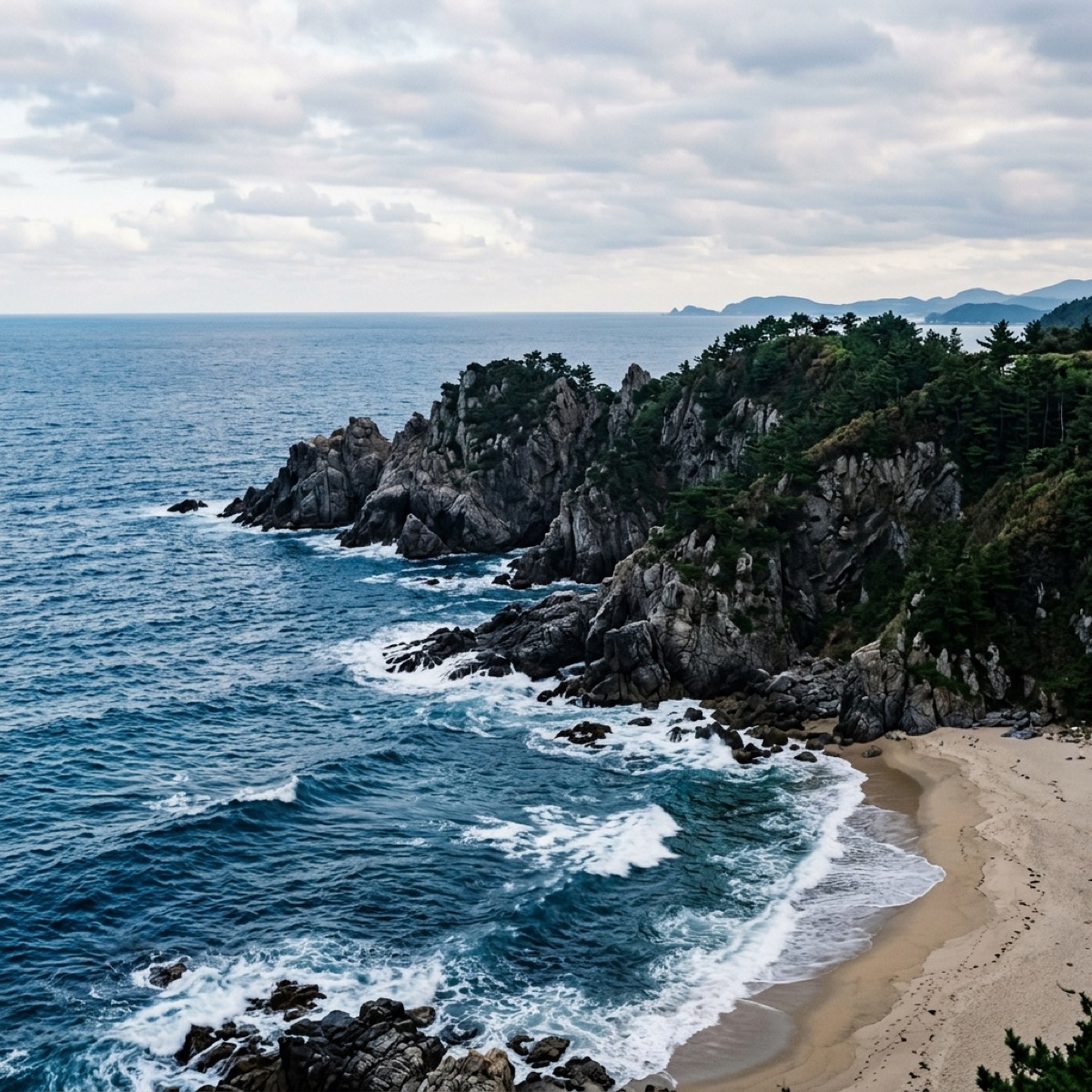
The East Sea — known internationally as the Sea of Japan — harbours one of Korea's richest cold-water marine ecosystems. The Gangneung–Samcheok coastline supports vast kelp forests (Saccharina japonica and Eisenia bicyclis) that function as underwater nurseries for over 340 fish and invertebrate species, including the commercially vital Korean snow crab (Chionoecetes opilio) and the endangered Steller sea lion.
Yet this coastline faces a mounting crisis. Each year, an estimated 18,000 tonnes of marine debris enters the East Sea from coastal communities, fishing operations, and trans-boundary ocean currents. Abandoned fishing nets — known as "ghost nets" — entangle marine mammals and smother the kelp forests that anchor the entire food web. Since 2018, Gangwon Province has recorded a 27% decline in kelp forest coverage, threatening both the marine ecosystem and the livelihoods of 4,200 fishing families who depend on healthy seas.
The East Sea Marine Cleanup Campaign is Dasom Saessak Initiative's flagship ocean programme. Operating in partnership with the Korea Marine Environment Management Corporation (KOEM) and Gangneung-Wonju National University's Marine Biology Lab, we combine large-scale debris removal with scientific kelp restoration to return this coastline to ecological health.
"Ghost nets are silent killers. A single abandoned gill net can continue trapping and killing marine life for 600 years. Removing them is not cleanup — it is rescue."
— Professor Park Soo-jin, Marine Ecology Lab, Gangneung-Wonju National University
The Challenge
Ghost Net Entanglement
An estimated 11,000 tonnes of derelict fishing gear lies on the East Sea floor off Gangwon Province. Ghost nets from squid and crab fisheries entangle Steller sea lions, green sea turtles, and diving seabirds — killing an estimated 3,800 marine animals annually in Korean waters alone.
Kelp Forest Die-off
Rising sea temperatures (up 1.4°C since 1968) combined with debris smothering have caused "isoyake" — barren ground events — across 27% of the Gangneung coast. Without kelp, juvenile fish populations collapse and the seabed erodes, triggering a cascading ecosystem failure.
Microplastic Contamination
KOEM sampling reveals that East Sea surface waters contain an average of 1,840 microplastic particles per km², among the highest densities in the Northwest Pacific. These particles bioaccumulate through the food chain, reaching the seafood consumed by millions of Koreans.
Trans-boundary Debris
Up to 40% of debris on Gangwon beaches originates from neighbouring countries, carried by the Tsushima Current. Styrofoam buoys from aquaculture operations constitute the single largest category, fragmenting into millions of microplastic particles upon landfall.
Our Approach
We deploy a four-pillar marine restoration strategy developed with KOEM and validated by the Northwest Pacific Action Plan (NOWPAP), a UNEP Regional Seas programme.
Underwater Survey & Debris Mapping
Before every cleanup operation, our certified dive teams conduct ROV (remotely operated vehicle) and side-scan sonar surveys to map ghost net concentrations, debris hotspots, and surviving kelp patches. We use GIS-integrated ocean floor maps — updated quarterly — to prioritise removal sites by ecological urgency, focusing on areas where debris directly threatens kelp recruitment zones or marine mammal corridors.
Large-Scale Debris Removal
Trained volunteer dive teams (PADI-certified, minimum Advanced Open Water) work alongside professional salvage divers to extract ghost nets, derelict traps, and bulk plastic from the seabed. Surface crews conduct synchronised beach cleanups along the high-tide line. All recovered debris is sorted, weighed, and logged into Korea's National Marine Litter Monitoring System (NMLMS) database for policy research.
Kelp Forest Restoration
Once debris is cleared, our marine biologists install "kelp seeding lines" — ropes inoculated with locally-sourced Saccharina japonica and Eisenia bicyclis spores cultivated at our partner hatchery in Jumunjin. Seeded lines are deployed on purpose-built reef structures at 5–15m depth, creating new substrate for kelp colonisation. Each 100m seeding line can regenerate approximately 200m² of kelp canopy within 18 months.
Community Science & Long-term Monitoring
Local fishing cooperatives and university students conduct monthly biodiversity transects at restoration sites, recording fish species counts, kelp canopy density, and water quality metrics. Data feeds directly into KOEM's national monitoring dashboard. We also run biannual microplastic sampling with haenyeo-led teams, giving coastal communities ownership of the scientific evidence base that drives local pollution policy.
Project Timeline & Milestones
Campaign Launch — First Dive Operation
MOU signed with KOEM, Gangneung City, and Gangneung-Wonju National University. First cleanup dive at Jeongdongjin Beach — 180 volunteer divers extracted 8,400 kg of ghost nets and derelict traps from a 2.4 km stretch of seabed in a single weekend.
Phase 1 Complete — 18 km Cleared
Completed first sweep of the Gangneung coastline from Jumunjin to Jeongdongjin. 32,000 kg of marine debris removed. ROV survey confirms debris coverage reduced by 64% in target zones. KOEM awards Dasom Saessak the "Marine Environment Protection Citation".
First Kelp Seeding Lines Deployed
450 metres of kelp seeding lines installed across 6 restoration zones at Sacheon and Jumunjin. Partnership with Jumunjin Fisheries Cooperative secures ongoing access to hatchery facilities and local ecological expertise from veteran haenyeo divers.
Kelp Recovery Confirmed — Marine Life Returns
Six-month monitoring reveals 72% kelp survival rate on seeding lines — exceeding 60% benchmark. Underwater transects document return of juvenile rockfish, abalone, and sea urchin populations to restored zones. First confirmed sea otter sighting in Gangneung waters in 11 years.
Phase 2 — Extending to Samcheok (In Progress)
Expanding cleanup operations south to the Samcheok coastline — an additional 20 km of heavily impacted shoreline. Deploying 6 new kelp restoration zones and launching Korea's first citizen-led microplastic baseline survey. Requires ₩7,500,000 more to reach our funding goal.
Full Corridor Handover — East Sea Blue Belt
Complete 38 km "Blue Belt" corridor to be designated a KOEM Marine Protected Area, with ongoing stewardship transferred to a coalition of local fishing cooperatives, university research groups, and Gangwon Provincial Government — ensuring permanent protection.
Latest Updates
Summer Dive Season Opens — 240 Volunteer Slots Available
Registration is now open for the 2025 summer dive cleanup season (May–September). We're recruiting 240 PADI-certified volunteer divers across 8 weekend operations targeting the new Samcheok expansion zone. All gear, boat transport, and dive insurance provided. Register here →
Q1 Kelp Monitoring: 84% Canopy Recovery in Zone A
Our latest underwater transect survey at the Jeongdongjin restoration site (Zone A) records 84% kelp canopy coverage — up from 12% at project baseline. Fish species diversity has increased from 14 to 31 species in restored areas. Full monitoring report available to donors. Download PDF →
NOWPAP Recognition — Best Practice Case Study
The UN Environment Programme's Northwest Pacific Action Plan (NOWPAP) has selected our campaign as a "Best Practice Case Study" for community-led marine debris management in the Northwest Pacific region. The recognition brings international visibility and opens access to UNEP technical assistance funding.