About This Project
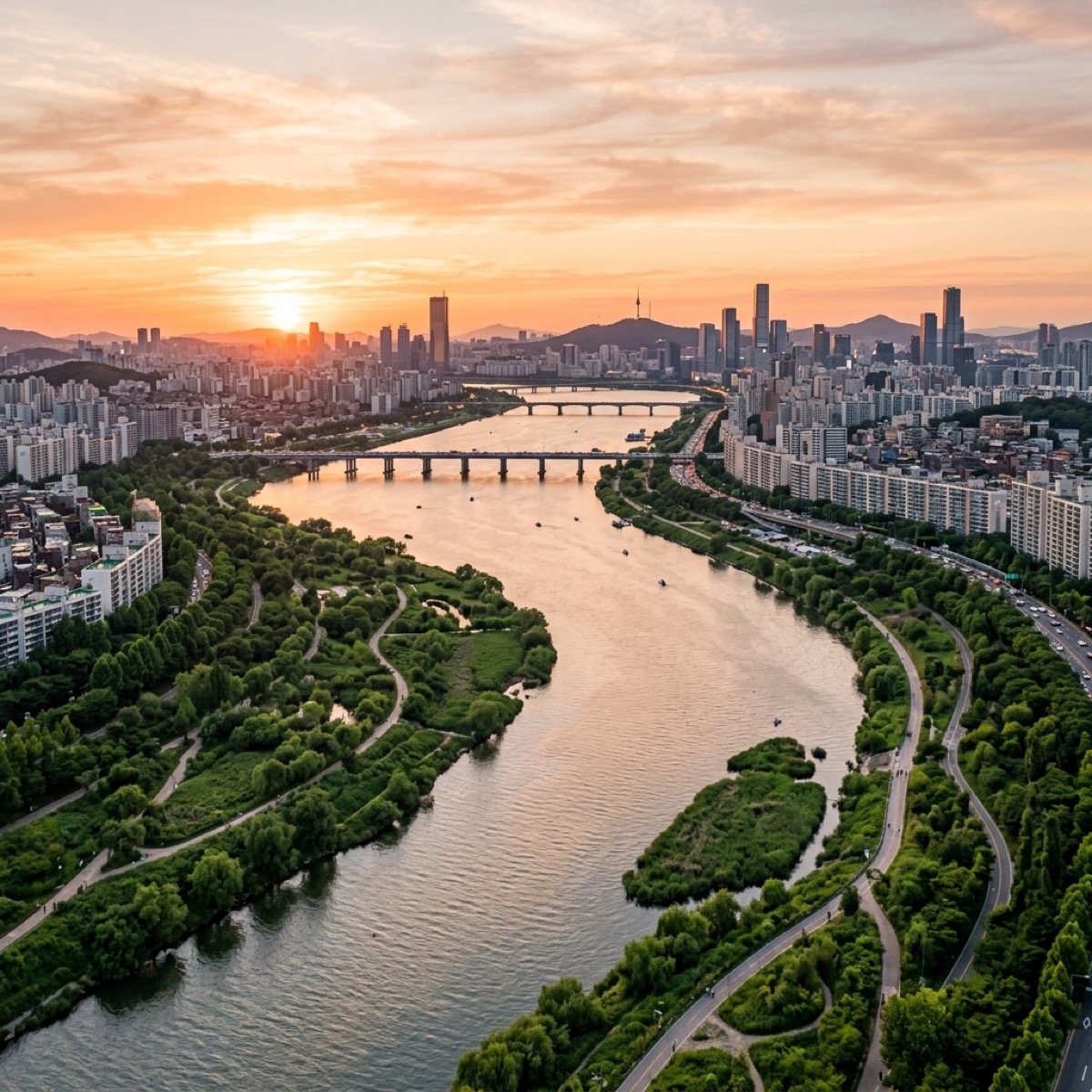
The Han River — 한강 — is Seoul's lifeline. It bisects a metropolitan area of 26 million people and has shaped Korean civilisation for over 2,000 years. But seven decades of rapid industrialisation and concrete flood-control engineering have severed almost every ecological link between the river and its surrounding landscapes.
Today, 84% of the Han River's Seoul-section banks are hardscaped — lined with concrete revetments, asphalt cycling paths, and manicured lawns. While visually tidy, these surfaces are biologically sterile. They support almost no invertebrate life, offer zero nesting or shelter for migratory birds, and funnel untreated urban stormwater directly into the river at velocities that scour the riverbed.
The Han River Eco-Corridor Development project is transforming 12 kilometres of riverbank between Yeouido and Ttukseom into a continuous native riparian habitat — a living corridor that reconnects fragmented wildlife populations, filters urban runoff naturally, and gives Seoul's 10 million residents access to genuine, functional nature within walking distance of the subway.
"Seoul doesn't lack green space — it lacks ecological space. A mowed lawn beside a concrete wall is not nature. A sedge meadow filtering runoff while egrets nest overhead — that's an ecosystem doing real work."
— Prof. Cho Kyung-hee, Seoul National University, Department of Landscape ArchitectureThis is not a beautification project. It is a functional ecological intervention — designed with hydrological engineers, riparian ecologists, and urban wildlife biologists to deliver measurable gains in biodiversity, water quality, and flood resilience, while creating the most ambitious urban nature corridor in Korean history.
The Challenges We Face
Concrete Monoculture
84% of Han River's Seoul banks are hardscaped. Concrete revetments block root penetration, prevent groundwater exchange, and create thermal barriers that raise river surface temperatures by up to 3°C in summer.
Habitat Fragmentation
Seoul's riverside parks are ecological islands — separated by highways, bridges, and flood infrastructure. Wildlife cannot move between patches, leading to genetic isolation and local extinctions of amphibians, otters, and ground-nesting birds.
Urban Runoff Pollution
During monsoon season, untreated stormwater carrying heavy metals, microplastics, and hydrocarbons from 9 million m² of impervious surface flushes directly into the Han through 340+ outfall pipes along our project corridor.
Urban Heat Island Effect
Concrete riverbanks absorb and re-radiate heat, contributing to Seoul's severe urban heat island — where summer riverside temperatures can exceed surrounding rural areas by 5–8°C, stressing both aquatic and riparian species.
Our Approach
We work in partnership with Seoul Metropolitan Government, KWATER, and three university research labs to implement a phased ecological conversion — replacing concrete with living infrastructure while maintaining the Han's critical flood-management function.
Hydrological Assessment & Design
Each 500-metre section receives a full hydrological survey: flood return modelling, soil permeability testing, and groundwater mapping. Our engineers design bioengineered bank profiles that handle 50-year flood events while allowing root colonisation — using coir rolls, live willow fascines, and graded cobble substrates instead of concrete.
Native Riparian Planting
We install species-specific plant palettes: submerged aquatics (water milfoil, pondweed) in the channel margin, emergent sedges and rushes in the splash zone, native willows and alders on the upper bank, and meadow wildflowers on the floodplain terrace. Every plant is sourced from Korean-origin nursery stock certified by the Korea National Arboretum.
Wildlife Corridor Engineering
Between each restored section, we construct wildlife underpasses beneath bridges and road crossings — amphibian tunnels, otter ledges, and bird-safe vegetation screens that allow animals to traverse the full 12 km corridor without encountering traffic. Five otter holts (artificial dens) have been installed at key crossing points.
Citizen Science Monitoring
1,200+ trained citizen scientists conduct monthly biodiversity transects along the corridor — recording bird counts, invertebrate samples, water quality (pH, dissolved oxygen, turbidity), and plant establishment rates. All data feeds into Seoul Metropolitan Government's open environmental database.
Project Timeline
Pilot Section Launch — Yeouido Saetgang
First 1.8 km section initiated at Yeouido's Saetgang Ecological Park extension. Concrete revetment removed from 600 m of bank. 4,200 native sedges, rushes, and willows planted.
First Wildlife Detections
Camera traps at the Yeouido pilot site recorded Eurasian otter activity — the first confirmed otter presence in the Yeouido section since 2009. Three species of kingfisher observed nesting in new bank profiles.
Phase 2 Expansion — Banpo to Jamwon
4.5 km extension from Banpo Bridge to Jamwon Hangang Park. Two amphibian underpasses and three otter holts installed. 18,000 native plants across 28 species established.
Phase 3 — Jamsil to Ttukseom Connection
The critical 5.7 km section connecting Jamsil to Ttukseom — completing the full 12 km corridor. Includes the most complex engineering: underpass construction beneath 4 major bridges and integration with Seoul Subway Line 2 ventilation infrastructure.
Full Corridor Inauguration
Continuous 12 km eco-corridor operational. First full-corridor wildlife census. Public opening of 6 riverside nature observation decks and educational signage trail.
Long-Term Monitoring & Replication
3-year post-completion monitoring programme. Partnership with Seoul Metropolitan Government to replicate the model on the Jungnangcheon and Anyangcheon tributaries — potentially extending the corridor network to 40+ km.
Latest Updates
Phase 3 groundbreaking at Jamsil — 240 volunteers plant 6,000 sedges
The largest single-day planting event in the project's history. Seoul Mayor attended the opening ceremony. Water quality sensors installed at 8 new monitoring stations.
Spring census: 37 species now using the corridor
Up from 12 species at project start. Notable returns include little egret, black-crowned night heron, and the Korean golden frog — classified as Vulnerable on the IUCN Red List. Full species report →
Otter family of four documented at Banpo section
Infrared camera footage confirmed a female Eurasian otter with three cubs using the artificial holt at Banpo — the first documented otter breeding in central Seoul in over 15 years.