About This Project
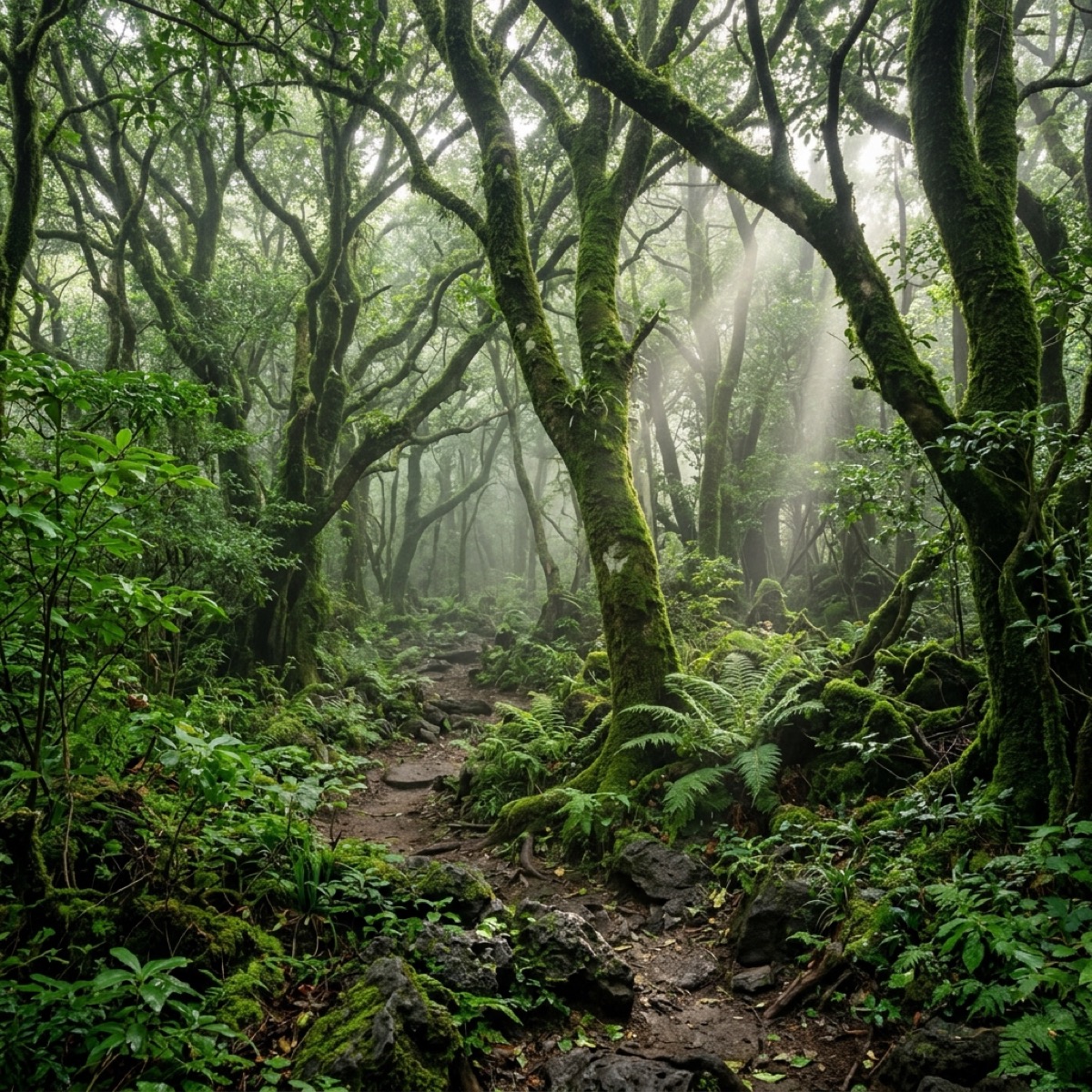
Jeju Island's Gotjawal forest — a UNESCO Biosphere Reserve — is one of Korea's most ecologically significant landscapes. This dense, lava-rock woodland is the island's primary water filter, recharging the volcanic aquifer that supplies fresh water to more than 670,000 residents. Yet over the past three decades, more than 31% of Gotjawal's original canopy has been cleared for agriculture, golf resorts, and urban development.
The Jeju Native Forest Restoration Project is Dasom Saessak Initiative's flagship field programme. Launched in partnership with Jeju Special Self-Governing Province and the Korea Forest Service, we work alongside local communities to systematically reverse this loss — one tree, one habitat patch at a time.
"The Gotjawal is not simply forest — it is the lungs and kidneys of Jeju Island. Without it, the freshwater table collapses. Restoring it is not a choice; it is an obligation."
— Dr. Kim Jeong-won, Lead Ecologist, Jeju National University
The Challenge
Invasive Species
Japanese black pine (Pinus thunbergii) and Casuarina trees, introduced in the 1970s, now dominate over 40% of degraded Gotjawal sites, outcompeting native Camellia, Machilus, and Cinnamomum species.
Groundwater Depletion
Gotjawal degradation has reduced aquifer recharge capacity by an estimated 18% since 1990, threatening the island's freshwater security and its designation as a UNESCO Global Geopark.
Biodiversity Collapse
14 endemic plant species and 6 endemic bird species — including the critically endangered Tristram's woodpecker — depend exclusively on intact Gotjawal for nesting and foraging habitat.
Climate Vulnerability
Rising temperatures and intensifying typhoon seasons have accelerated soil erosion on deforested slopes, with landslide risk increasing by 34% in buffer zones since 2010.
Our Approach
We use a three-phase ecological restoration methodology developed in collaboration with the National Institute of Forest Science (NIFoS) and peer-reviewed by the Society for Ecological Restoration (SER) Korea Chapter.
Site Assessment & Community Mapping
Before any planting begins, our ecologists conduct a six-month baseline survey measuring soil composition, hydrology, and existing flora density. Crucially, we hold community consultations with Jeju's haenyeo (diving women) cooperatives and oreum (hill) farming communities to integrate traditional ecological knowledge into each site plan.
Invasive Removal & Soil Rehabilitation
Trained removal teams clear target areas of invasive conifers and undergrowth using manual methods to minimise soil disturbance. We apply Jeju's own volcanic basalt gravel as a mulching layer to restore the distinctive lava-field microclimate that native seedlings require to establish.
Native Replanting & Long-term Monitoring
All seedlings are propagated in our partner nurseries on Jeju from locally-sourced seed stock — never purchased from mainland suppliers — preserving the island's unique genetic heritage. Planted sites are monitored quarterly for five years using sensor networks and citizen-science volunteer surveys.
Project Timeline & Milestones
Project Launch
MOU signed with Jeju Province and Korea Forest Service. First pilot site (2.4 ha) at Seonheul Gotjawal established. 3,800 Camellia japonica saplings planted with 420 volunteers.
Phase 1 Complete — 12 ha Restored
First-year survival rate of 91.4%, exceeding the 85% industry benchmark. NIFoS soil analysis confirms measurable improvement in water percolation rates in treated zones.
Tristram's Woodpecker Documented
Wildlife camera survey at Bukchon Gotjawal site captured the first confirmed nesting pair of Tristram's woodpecker in a restored zone. A landmark indicator of ecosystem recovery.
Phase 2 Complete — 87 ha Total
₩45,200,000 raised. 142,000+ native trees in ground across 7 restoration zones. SER Korea awards the project its Annual Restoration Excellence Award.
Phase 3 — Scaling to 200 ha (In Progress)
Target: expand to the Hamdeok and Gujwa Gotjawal corridors, connecting fragmented habitat patches into a continuous 200 ha wildlife corridor. Requires ₩4,800,000 more to reach our goal.
Project Completion — Handover to Community Trust
Full 200 ha corridor to be handed over to a locally-governed Gotjawal Community Conservation Trust for ongoing stewardship — ensuring permanent protection beyond our project term.
Latest Updates
Spring Planting Season Opens — 8,000 Seedlings Ready
Our Jeju nursery has completed propagation of 8,000 seedlings across 12 native species for the 2025 spring planting window. Volunteer recruitment for the April 26–27 planting weekend is now open. Register here →
Q1 Monitoring Report: 94% Seedling Survival Rate
Our latest quarterly field survey across all Phase 2 restoration zones confirms a 94.1% seedling survival rate — our highest ever — following last summer's enhanced soil-moisture management protocol. Full report available to donors. Download PDF →
Phase 3 MOU Signed with Gujwa County
Dasom Saessak Initiative has formally signed a Memorandum of Understanding with Gujwa County Government to access 55 ha of degraded Gotjawal land for Phase 3 restoration work commencing April 2025.