About This Project
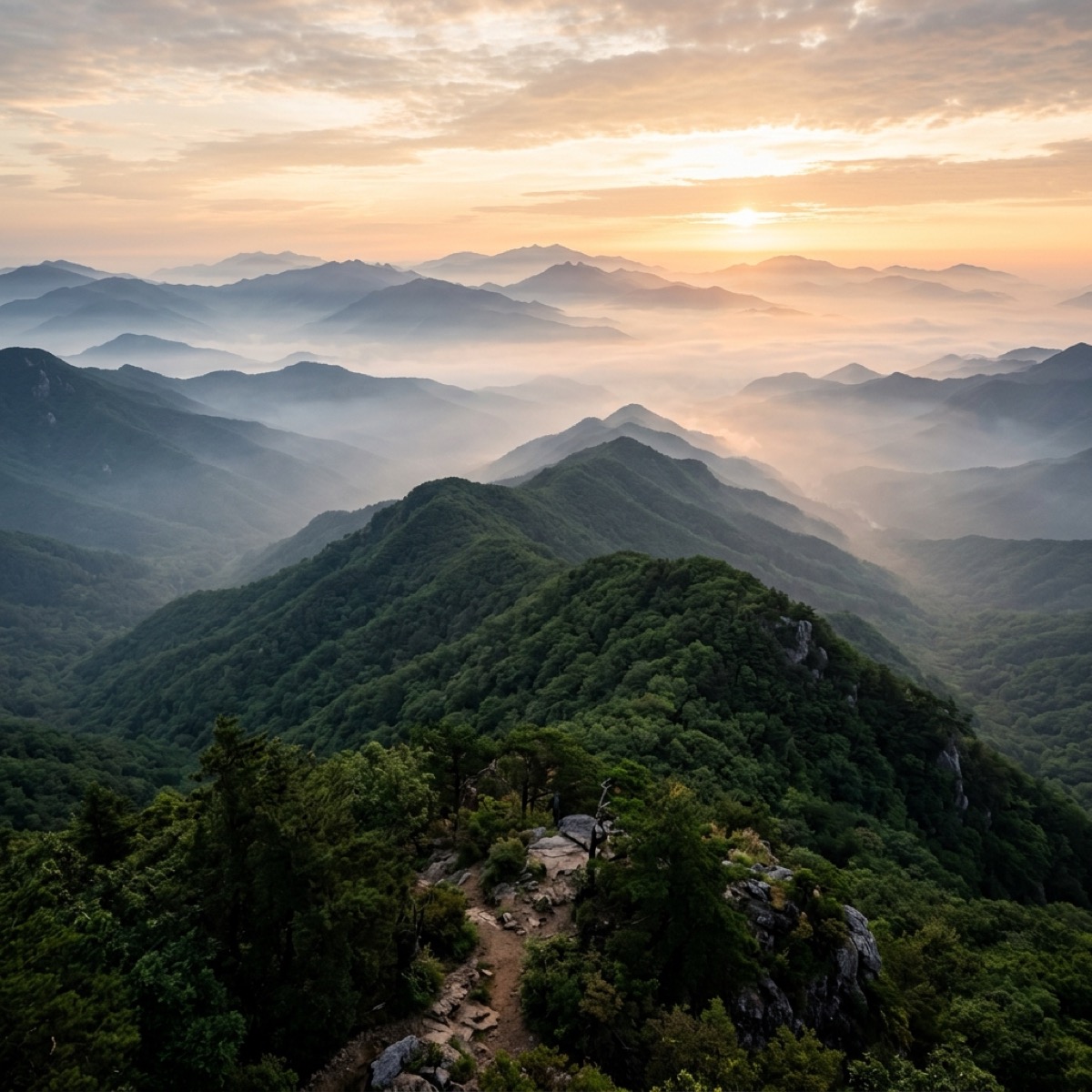
Jirisan (지리산) — literally "Mountain of the Wise" — was designated Korea's first national park in 1967. Spanning 472 km² across three provinces and five counties, its peaks rise to 1,915 metres at Cheonwangbong, making it the highest point on the Korean mainland. Its forests are among the oldest on the peninsula: mixed deciduous stands of Mongolian oak, Korean pine, and Japanese zelkova that have developed undisturbed for centuries in its remotest valleys.
Jirisan is the last significant refuge for the Asiatic black bear (Ursus thibetanus ussuricus) on the Korean peninsula. In 2001, the Korea National Park Service began a reintroduction programme with just 6 bears. Today, the population has grown to approximately 76 individuals — a remarkable recovery, but still critically below the minimum viable population of 150 that geneticists consider necessary for long-term survival without inbreeding depression.
Our project fills the gaps that institutional management cannot cover alone: supplementary camera-trap monitoring in the park's 120 km of ungoverned border zones, community anti-poaching education in surrounding villages, invasive plant removal from old-growth understory, and a citizen-science programme that trains 300+ volunteers annually to conduct standardised biodiversity transects feeding into the Korea National Biodiversity Database.
"The park service protects the core. But bears don't read boundary maps. Seventy percent of human-bear conflict happens in the 5-kilometre buffer zone outside the official boundary — and that's exactly where this team operates."
— Dr. Han Sang-hoon, Head of Wildlife Research, Korea National Park Research InstituteThe Challenges We Face
Human-Bear Conflict
As the bear population expands, animals increasingly venture into agricultural areas surrounding the park to forage on persimmon, chestnut, and beehives. In 2024, 23 crop-damage reports were filed. Without intervention, farmers resort to illegal snares — the leading cause of unnatural bear mortality on Jirisan.
Illegal Snare & Trap Networks
Wire snares set for wild boar and deer inadvertently trap bears, Siberian weasels, and Korean gorals. Our patrol teams have recovered 340+ snares from the buffer zone since 2022. Many are set along traditional game trails that overlap with critical bear dispersal corridors.
Pine Wilt Disease
The pine wood nematode (Bursaphelenchus xylophilus), spread by the Japanese pine sawyer beetle, has killed over 8,000 Korean pines in Jirisan since 2019. These pines are critical mast-producers for bears preparing for winter hibernation and provide canopy structure for the park's 1,800+ recorded plant species.
Elevational Shift
Climate modelling predicts that Jirisan's subalpine zone — home to Korean fir (Abies koreana), a species endemic to South Korea and classified as Endangered — will lose 70% of suitable habitat by 2050 as temperature isotherms shift upslope faster than tree species can migrate.
Our Approach
We work alongside the Korea National Park Service (KNPS) and the National Institute of Ecology, focusing on buffer-zone operations and community engagement that fall outside the park's core management mandate.
Camera Trap Surveillance Network
124 infrared camera stations — 80 inside the park boundary and 44 in the buffer zone — capture over 180,000 images per month. Our AI-assisted identification pipeline (trained on 2.4 million labelled images) auto-classifies species detections, flagging bear movements in real time to both our field team and the KNPS Wildlife Division. In 2024, this system identified 3 previously uncatalogued bears and tracked 2 females with cubs across 14 km of dispersal corridor.
Buffer Zone Patrol & Snare Removal
Volunteer patrol teams walk 120 km of buffer-zone trails twice monthly from March to November. Every recovered snare is GPS-tagged, photographed, and reported to KNPS enforcement. We also install bear-proof waste bins at 18 trailhead car parks and distribute electric fencing kits to farms within 3 km of confirmed bear corridors — 47 farms equipped to date.
Old-Growth Understory Restoration
In pine-wilt-affected zones, we remove dead trees (preventing beetle breeding sites) and replant with climate-resilient native species — Korean maple, stewartia, and hornbeam — that provide alternative mast crops for bears and structural diversity for forest birds. 2,400 trees planted in 2024 across 6 hectares of affected forest.
Citizen Biodiversity Survey Programme
300+ trained citizen scientists conduct quarterly transects across 40 standardised plots. Surveys cover vascular plants, breeding birds, amphibians, and macro-invertebrates. All data is quality-checked and submitted to the National Ecosystem Survey Database (국가생태조사) and the Global Biodiversity Information Facility (GBIF). In 2024, citizen surveyors added 14 species records new to the Jirisan catalogue.
Project Timeline
Project Launch & First Camera Grid
Initial deployment of 60 camera traps across Nogodan–Piagol corridor. Baseline mammal survey recorded 22 large-mammal species including 8 confirmed individual bears identified by chest-patch pattern analysis.
Buffer Zone Patrol Network Established
140 trained volunteers began twice-monthly patrols. 87 snares recovered in the first season. MOU signed with Gurye County to co-fund electric bear-fencing for agricultural properties.
AI Image Classification Deployed
Camera trap processing automated. Time from image capture to species-level classification reduced from 3 weeks (manual) to 4 hours. Bear individual identification accuracy: 89% using chest-patch matching algorithm developed with KAIST computer science lab.
Full Grid Expansion & Pine-Wilt Replanting
Camera network expanded to 124 stations. 340+ total snares recovered to date. 2,400 climate-resilient trees planted in pine-wilt zones. Citizen survey programme launched with 300+ volunteers across 40 standardised plots.
Dispersal Corridor Mapping & Farm Coexistence Scale-Up
GPS collar data (shared by KNPS) combined with camera trap detections to produce the first complete map of bear dispersal corridors outside the park boundary. Electric fencing target: 80 farms by December.
Korean Fir Conservation Assessment
Full census of Jirisan's subalpine Korean fir population in partnership with NIE. Seed bank collection programme for ex-situ conservation. Climate adaptation planting trial at 1,400–1,600 m elevation with cold-hardy Korean fir genotypes.
Latest Updates
Spring patrol recovers 18 snares — bear with cub photographed at Piagol
Camera station PG-07 captured a female bear (ID: JR-F22) with a single cub — confirming successful reproduction for the third consecutive year at this site. Two wire snares were found within 800 m of the den.
AI system reaches 92% individual bear identification accuracy
Updated model trained on 3.1 million images now identifies 68 of 76 known individuals by chest-patch pattern alone. KAIST collaboration paper accepted at the Wildlife Technology Conference, Seoul. Read the abstract →
Citizen survey adds 14 new species to Jirisan catalogue
2024 annual results published. Notable additions: Korean brown frog (Rana coreana) confirmed at 1,200 m — 300 m above its previously known upper range limit — suggesting climate-driven upslope range expansion. Data submitted to GBIF.