About This Project
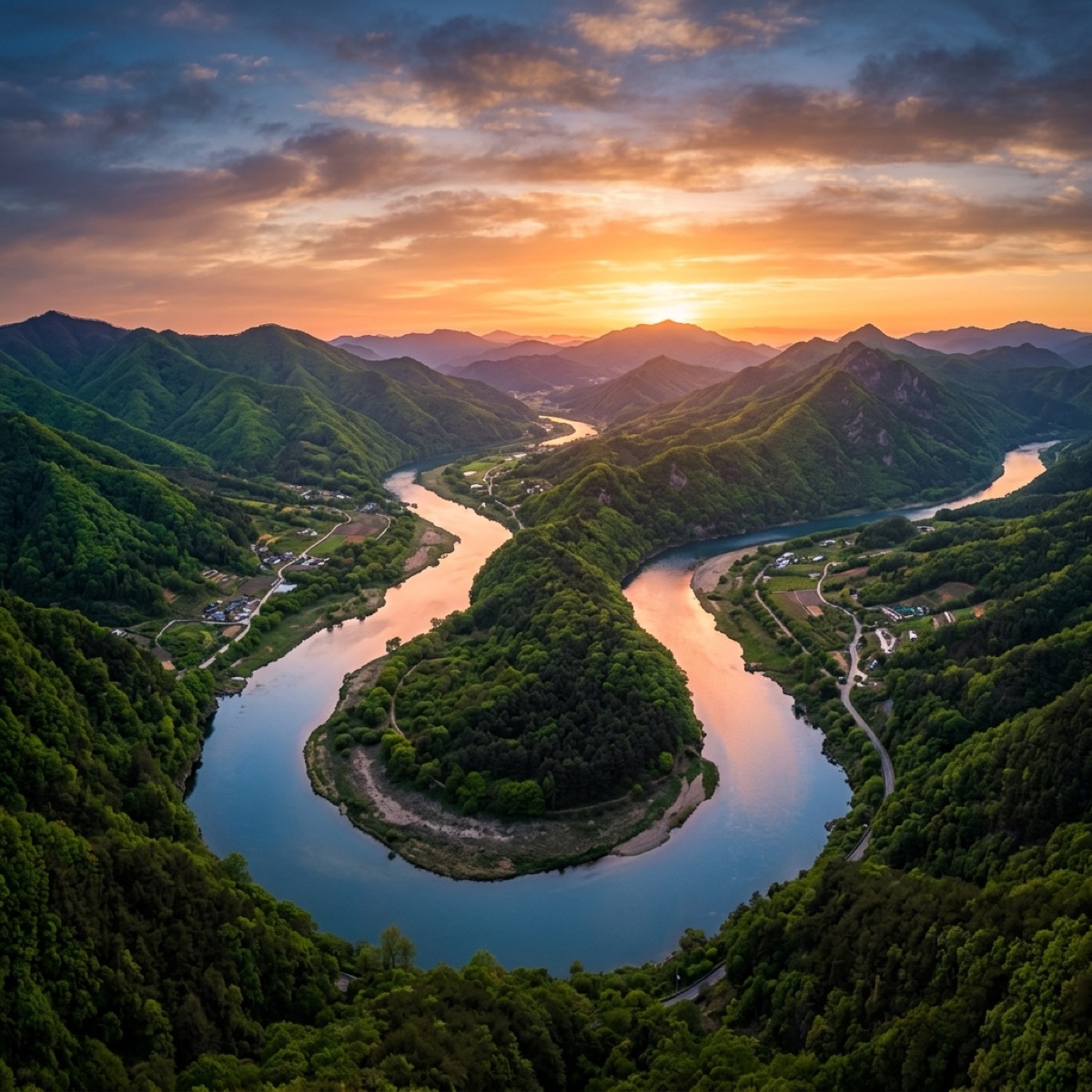
The Nakdong River (낙동강) is South Korea's longest, flowing 510 kilometres from its source at Hwangji Pond in Andong through the agricultural heartlands of Gyeongsang Province before emptying into the Korea Strait at Busan's Eulsukdo estuary. Its basin covers 23,384 km² — nearly a quarter of the Korean peninsula's landmass — and supplies drinking water to 13 million people across Daegu, Busan, Ulsan, and Changwon.
But the river is in trouble. Decades of industrial development, intensive agriculture, and four controversial river-channelling weirs installed under the 2009 Four Rivers Project have fundamentally altered the Nakdong's hydrology. Algal blooms — particularly toxic Microcystis cyanobacteria — now occur annually in the sluggish impoundments behind the weirs, occasionally forcing Busan to shut down water intake facilities. Agricultural runoff from 340,000 hectares of rice paddy and greenhouse farming contributes an estimated 4,600 tonnes of excess nitrogen and 380 tonnes of phosphorus per year to the river system.
Our project takes a nature-based solutions approach: constructing treatment wetlands at critical tributary confluences to filter pollutants before they reach the main channel, deploying a real-time sensor network to detect pollution events within hours, replanting riparian buffer strips to slow overland runoff, and training farming communities in reduced-input agriculture — all while generating the publicly accessible data that policymakers need to make informed decisions about the river's future.
"You can't legislate water quality into existence. You have to build the landscapes that produce it — wetlands that filter, buffers that slow, and communities that care. That's what makes this project different from another monitoring study."
— Prof. Shin Jae-ho, Pusan National University, Department of Environmental EngineeringThe Challenges We Face
Toxic Algal Blooms
The four weirs installed in 2012 reduced the Nakdong's flow velocity by up to 60% in impounded sections. In summer, water temperatures above 25°C combined with excess nutrients trigger Microcystis blooms that produce microcystin — a liver toxin — at concentrations exceeding WHO recreational water limits in 2023 and 2024.
Agricultural Non-Point Pollution
340,000 hectares of farmland drain into the Nakdong basin. Conventional rice paddy management uses 180 kg/ha of nitrogen fertiliser — 40% of which runs off during monsoon flooding. Greenhouse horticulture along tributaries in Miryang and Changnyeong adds concentrated phosphorus and pesticide loads.
Legacy Industrial Contamination
The Gumi–Waegwan industrial corridor upstream hosts electronics, petrochemical, and textile manufacturing. While point-source discharges are regulated, legacy heavy metal contamination (chromium, zinc) in riverbed sediments continues to leach during high-flow events, particularly affecting the Geumho River tributary.
Estuary Ecosystem Decline
The Nakdong Estuary Barrage, built in 1987 to prevent saltwater intrusion, has blocked migratory fish passage and eliminated tidal flushing in the lower river. Eulsukdo Island — once Korea's premier shorebird site — has lost 34% of its mudflat area to sediment starvation since the barrage's construction.
Our Approach
We partner with K-water, Pusan National University, and 6 county governments to implement nature-based water quality interventions at the landscape scale — targeting the tributaries and agricultural margins where treatment is most effective and most needed.
Constructed Treatment Wetlands
We design and build multi-cell treatment wetlands at tributary confluences — the points where polluted water enters the main Nakdong channel. Each wetland uses a sequence of sedimentation basins, horizontal subsurface-flow beds planted with common reed and cattail, and final polishing ponds. The four wetlands operational to date treat a combined 18,000 m³ of water daily, achieving average phosphorus removal of 41% and nitrogen removal of 38%.
Real-Time Water Sensor Network
32 solar-powered multi-parameter sensors deployed at 15-km intervals from Andong to the Eulsukdo estuary. Each station measures dissolved oxygen, chlorophyll-a (algae indicator), turbidity, conductivity, pH, and water temperature every 10 minutes. Data streams to an open-access dashboard and triggers SMS alerts to K-water and local water authorities when bloom-risk thresholds are approached.
Riparian Buffer Restoration
Along 26 km of priority tributary banks (selected by runoff modelling), we plant 10-metre-wide native buffer strips — willow, alder, and sedge meadow — that intercept overland agricultural runoff, slow water velocity, and trap sediment before it reaches the stream channel. 14 km of buffer established to date; sediment capture monitoring shows 62% reduction in suspended solids at downstream gauges.
Farmer Watershed Stewardship Programme
We work with 240+ rice farmers across 6 villages in Changnyeong and Hapcheon counties on reduced-input cultivation methods: slow-release fertiliser application, winter cover-cropping to reduce spring nitrogen flush, and controlled drainage systems that hold paddy water for an additional 3 days before release. Participating farms have reduced nitrogen runoff by an average of 28% compared to conventional practice.
Project Timeline
Project Launch & Sensor Network Phase 1
First 12 water quality sensors deployed between Hapcheon Weir and Changnyeong-Haman Weir — the most bloom-prone section. Baseline water quality assessment completed across 28 sampling points. Partnership agreements signed with K-water and Changnyeong County.
First Constructed Wetland Operational — Changnyeong
2,200 m² treatment wetland at the Topyeong-cheon confluence. Designed to process 4,500 m³/day of tributary water before it enters the Nakdong. 6,000 reed and cattail plants installed. Phosphorus removal exceeded design targets within 3 months.
Full Scale-Up: 3 More Wetlands, 20 More Sensors, Farmer Programme
Wetlands built at Hapcheon-cheon, Miryang-gang, and Geumho-gang confluences. Sensor network expanded to 32 stations covering full 510 km. Farmer stewardship programme enrolled 240 farmers across 6 villages. 14 km of riparian buffer planted.
Bloom Early-Warning System & Buffer Expansion
Integrating sensor data with weather forecasting to build a predictive algal bloom model — targeting 72-hour advance warning for water authorities. Riparian buffer planting target: 26 km total by December. Two additional treatment wetlands in design phase for the lower Nakdong near Gimhae.
Policy Submission: Nature-Based Water Treatment Standard
Compiling 3 years of treatment wetland performance data into a formal policy recommendation to the Ministry of Environment — proposing constructed wetlands as a regulated complement to conventional wastewater treatment for agricultural non-point source pollution nationwide.
Latest Updates
Bloom early-warning system issues first successful 48-hour advisory
Chlorophyll-a concentrations at Station 18 (Changnyeong) triggered a predictive alert on May 4. K-water pre-activated intake adjustments at the Busan water treatment plant. Bloom peaked on May 6 as predicted — no supply disruption.
Farmer programme results: 28% nitrogen reduction across participating farms
First full-year performance data from 240 farms in Changnyeong and Hapcheon. Slow-release fertiliser adoption reached 72%. Controlled drainage adoption reached 54%. Total estimated nitrogen prevented from entering the Nakdong: 86 tonnes. Full report →
Changnyeong wetland celebrates 1 year — 1.6 million m³ treated
The first constructed wetland has processed 1.6 million m³ of tributary water since commissioning. Average phosphorus removal: 43%. Reed and cattail biomass now self-sustaining — no replanting required. Kingfisher nesting confirmed in the polishing pond banks.