About This Project
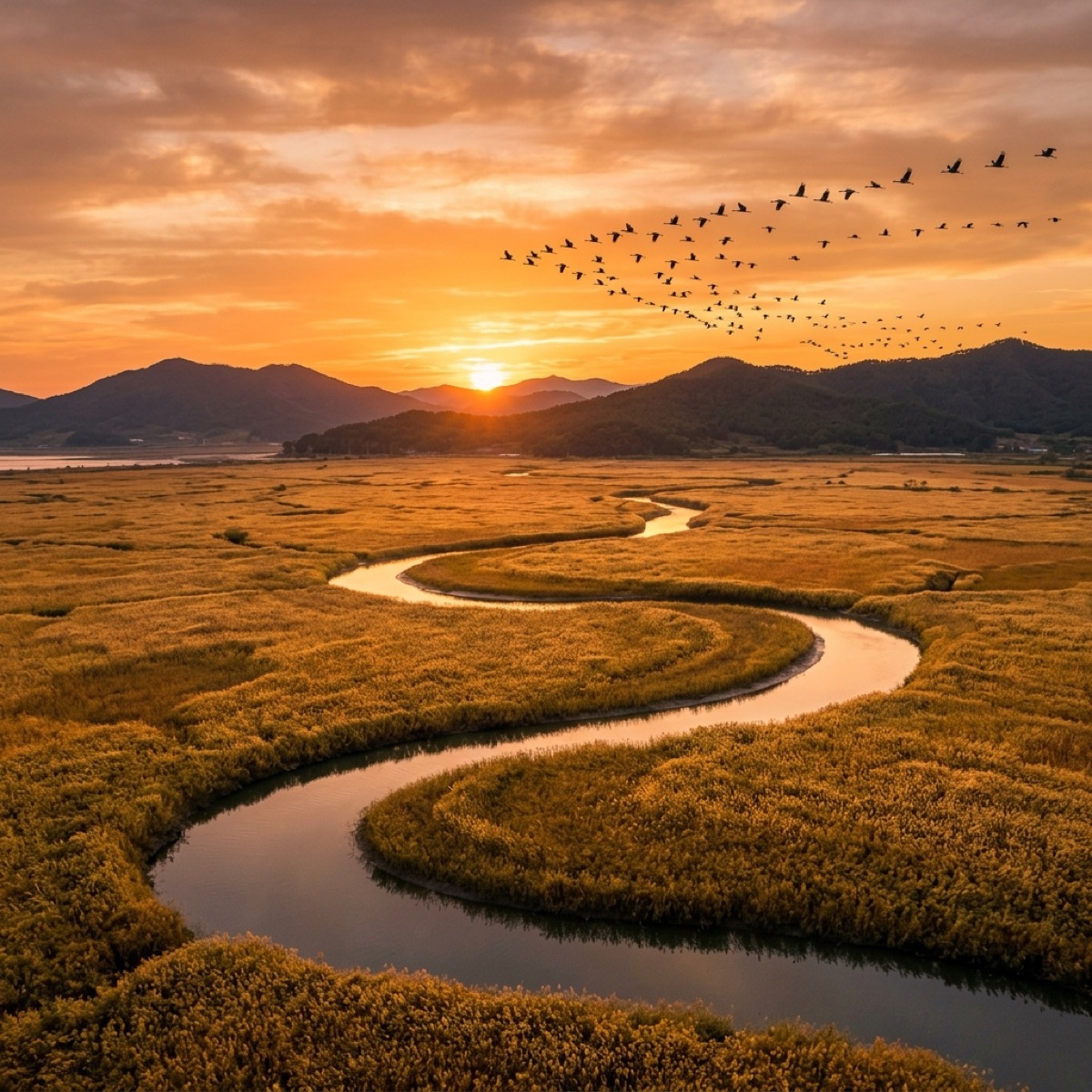
Suncheon Bay (순천만) is no ordinary wetland. Designated as Korea's first coastal Ramsar Wetland of International Importance in 2006, it shelters 5.5 square kilometres of pristine tidal mudflat fringed by the largest unbroken reed bed in East Asia — a 30-hectare expanse of common reed (Phragmites australis) that turns the bay into a golden sea every autumn and draws over 3 million visitors a year.
But Suncheon Bay's true value lies beneath the surface. Its mudflats function as one of the most productive ecosystems on the Korean peninsula — sequestering an estimated 12,600 tonnes of carbon annually in their anaerobic sediments, filtering agricultural runoff from the Dongcheon River catchment, and providing critical refuelling habitat for 143 recorded bird species along the East Asian–Australasian Flyway, including the globally endangered hooded crane (Grus monachus), of which only 11,600 individuals remain worldwide.
Our role is focused and specific: we address the threats that fall outside the government's protected-area management scope — invasive species encroachment, peripheral development pressure, agricultural runoff monitoring, and community-based bird census work — operating as the on-the-ground conservation partner that connects Suncheon Bay's formal designation with the daily ecological stewardship needed to keep it functional.
"A Ramsar designation protects a wetland on paper. What protects it in practice is someone counting the cranes every morning, pulling out the cordgrass every season, and testing the water every week. That's what this team does."
— Dr. Bae Soo-yeon, Wetland Ecologist, Suncheon Bay National Garden Research CentreThe Challenges We Face
Invasive Spartina Spread
Smooth cordgrass (Spartina alterniflora) — introduced accidentally via ship ballast water — has colonised 4.2 hectares of the bay's mudflat since 2018. It outcompetes native salt-marsh plants, traps sediment, and raises the mudflat elevation, making it unsuitable for shorebird foraging.
Agricultural Runoff
The Dongcheon River drains 660 km² of intensive rice paddies and livestock operations before entering Suncheon Bay. Elevated nitrogen and phosphorus levels drive seasonal algal blooms in the upper bay, reducing dissolved oxygen and threatening benthic invertebrate communities that cranes depend on.
Buffer Zone Development
While the inner bay is protected, surrounding agricultural land is under growing pressure for tourism infrastructure, solar farms, and residential development. Each hectare of buffer zone lost reduces the wetland's capacity to absorb flood surges and diminishes the acoustic buffer that wintering cranes require.
Climate-Driven Shifts
Rising sea levels and warmer winters are altering mudflat sediment dynamics and shifting the timing of invertebrate emergence — creating a mismatch between crane arrival dates and food availability. Monitoring these changes is critical to adaptive management.
Our Approach
We operate in close coordination with Suncheon City's Wetland Management Office and the National Institute of Ecology (NIE), filling the operational gaps between institutional oversight and daily stewardship.
Spartina Eradication Programme
Teams of 15–20 trained volunteers work in monthly rotations during the April–October growing season to manually extract Spartina from the mudflat — root systems included. We've learned that mechanical removal alone fails; our protocol combines manual extraction with biodegradable geotextile smothering mats on cleared patches to prevent re-establishment. 2,800 plants removed in 2024 across 1.6 hectares.
Water Quality Sentinel Network
16 solar-powered monitoring stations deployed along the Dongcheon River and bay perimeter measure dissolved oxygen, nitrogen, phosphorus, pH, and turbidity in real time. Data is uploaded to a public dashboard every 15 minutes and alerts our team and Suncheon City's environmental office when levels breach thresholds — triggering upstream source investigation within 48 hours.
Community Bird Census
Every winter from November to February, our volunteer network conducts weekly population counts of wintering cranes, geese, and shorebirds across 8 designated observation zones. Our census data is submitted to the East Asian–Australasian Flyway Partnership (EAAFP), BirdLife International, and the Korean Ministry of Environment's National Species Database.
Buffer Zone Advocacy & Education
We run a year-round community engagement programme with 12 farming villages in the Dongcheon River catchment — providing technical guidance on reduced-fertiliser rice cultivation (친환경 쌀), hosting monthly "Wetland Neighbours" meetings, and working with Suncheon City's planning office on buffer-zone zoning recommendations.
Project Timeline
Project Launch & Baseline Survey
Comprehensive ecological baseline: GPS-mapped all Spartina colonies, established 16 water monitoring stations, completed first full winter bird census (recorded 4,180 hooded cranes, 2,240 white-naped cranes, and 890 white-fronted geese).
First Spartina Eradication Season
7 monthly extraction campaigns. 2,800 individual plants removed from 1.6 hectares. Geotextile mats installed on 0.8 hectares of cleared mudflat. 92% non-regrowth rate observed in mat-covered areas versus 45% in extraction-only areas.
Second Winter Census
Weekly counts across 8 zones. Hooded crane numbers up 6% year-on-year (4,430 individuals). First confirmed sighting of Baer's pochard — a critically endangered diving duck with fewer than 1,000 individuals globally — at the Dongcheon River mouth.
Season 2 Spartina Campaign + Eco-Farming Pilot
Targeting remaining 2.6 hectares of Spartina. Simultaneously launching reduced-fertiliser rice pilot with 8 farms in the upper Dongcheon catchment — aiming for 30% nitrogen reduction in paddy runoff by September.
Suncheon Bay Wetland Health Report Card
First annual public report on wetland condition — synthesising water quality trends, bird population data, Spartina coverage change, and buffer zone status. To be presented at the Suncheon Bay International Wetland Forum.
Full Spartina Elimination & Monitoring Scale-Up
Target: zero active Spartina colonies in the inner bay. Expansion of water monitoring network to 24 stations. Application to Ramsar Secretariat for updated site management plan reflecting community-based stewardship model.
Latest Updates
Season 2 Spartina campaign launches — 85 volunteers mobilised
First extraction weekend cleared 0.4 hectares of new cordgrass growth on the eastern mudflat. Drone imagery confirms 2024 geotextile mats holding with 94% suppression rate.
Winter census concludes — Baer's pochard confirmed for second year
4,430 hooded cranes counted (6% increase). Two Baer's pochards documented at Dongcheon mouth for 12 consecutive weeks — suggesting the bay may be becoming a regular wintering site. Data submitted to EAAFP. Full census report →
Water quality alert: elevated phosphorus traced to upstream dairy operation
Station 11 triggered a threshold breach on December 3. Our team identified the source within 36 hours. Suncheon City's environmental office issued a corrective order. Levels returned to baseline within 10 days — demonstrating the sentinel network's value.